Artisan story
Pottery from Patambán
Patambán pottery begins with the ground the town stands on. Red earth, white line work, and seventy years of practice in one pair of hands.
Charanda clay, the red soil of Michoacán
Patambán is a Purépecha town in Michoacán, and its pottery starts with what is underfoot. The clay is charanda, a word that means red soil, and it gives every piece its color before anyone draws a line on it. That red is warm under a lamp and quiet in daylight. It is not the orange of a garden planter or the gray-brown of unglazed stoneware, and you can pick it out from across a room.
Over that ground the decoration is white, laid on in fine detail, dense enough to hold your eye without shouting. From a few steps back you read the shape. Up close you find the line.
The color is the material rather than a finish applied on top. When a piece chips, the red runs all the way through, which is part of why these vessels age well instead of simply wearing out.
The hand of Don Neftalí Ayungua
The collection we carry reflects the mastery of Don Neftalí Ayungua, recognized as a Great Master of Mexican Folk Art by Fomento Cultural Banamex. For over 70 years he has made pieces from the region's charanda clay, finished with the delicate white detail the work is known for.
Seventy years shows up in the proportions. A lid sits where your hand expects a lid to sit. A handle is the width you reach for. The ornament never crowds the vessel underneath it.
That is the first thing we look for, and it is the part that takes a lifetime to arrive at.
What the work looks like up close
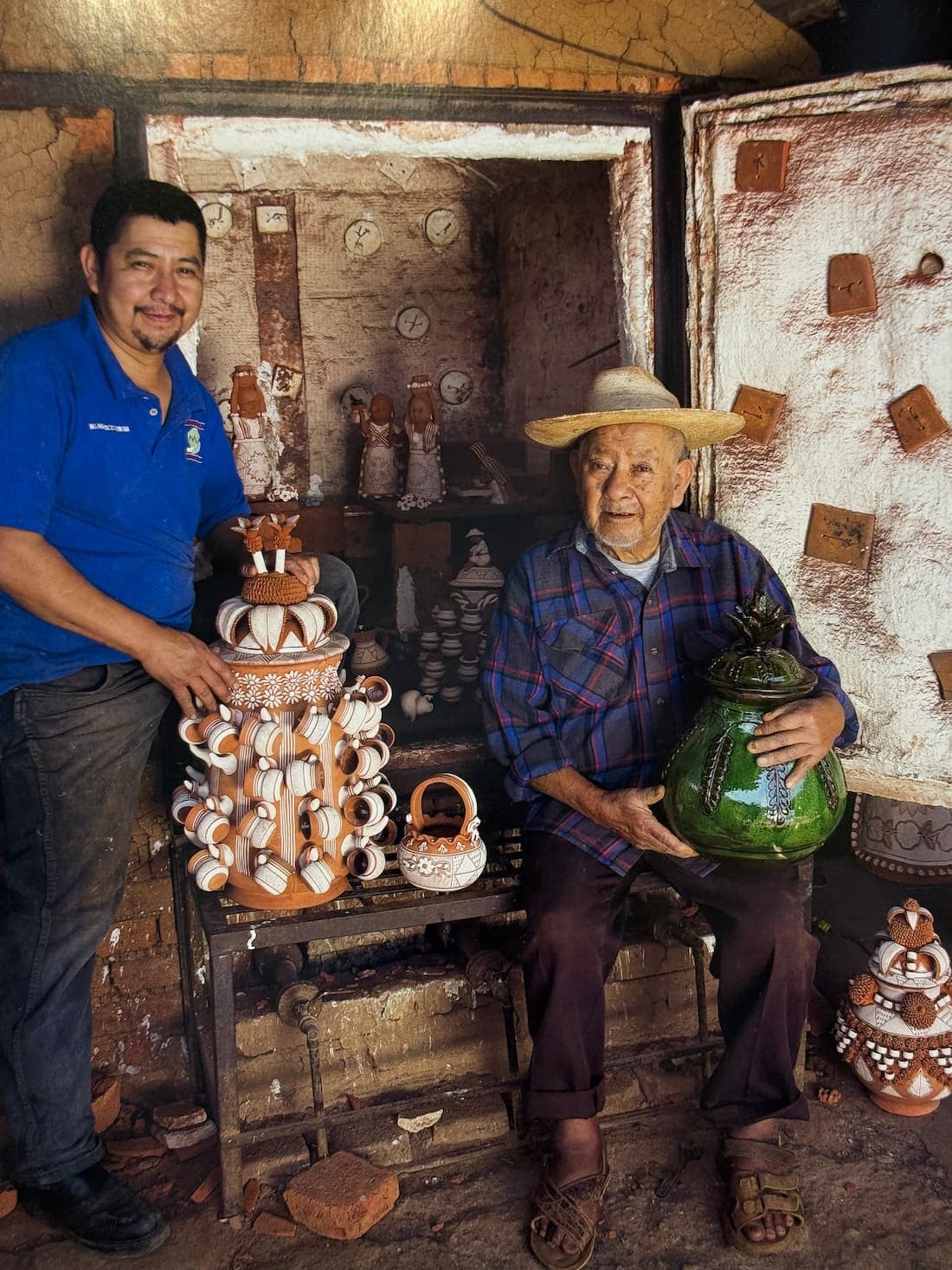
In one of our photographs the two men stand together in the workshop, shelves of finished work behind them. One holds a tall tiered piece, ringed with small cups and crowned with modeled leaves. The other cradles a deep green glazed jar, both hands underneath it.
Elsewhere the same vocabulary turns up in different arrangements. Lidded vessels carry modeled foliage at the crown. Rounded bodies are banded with fine white combing that reads like lace from a few steps back and resolves into single strokes when you lean in. One lidded piece is finished with a small seated figure where a knob would usually go.
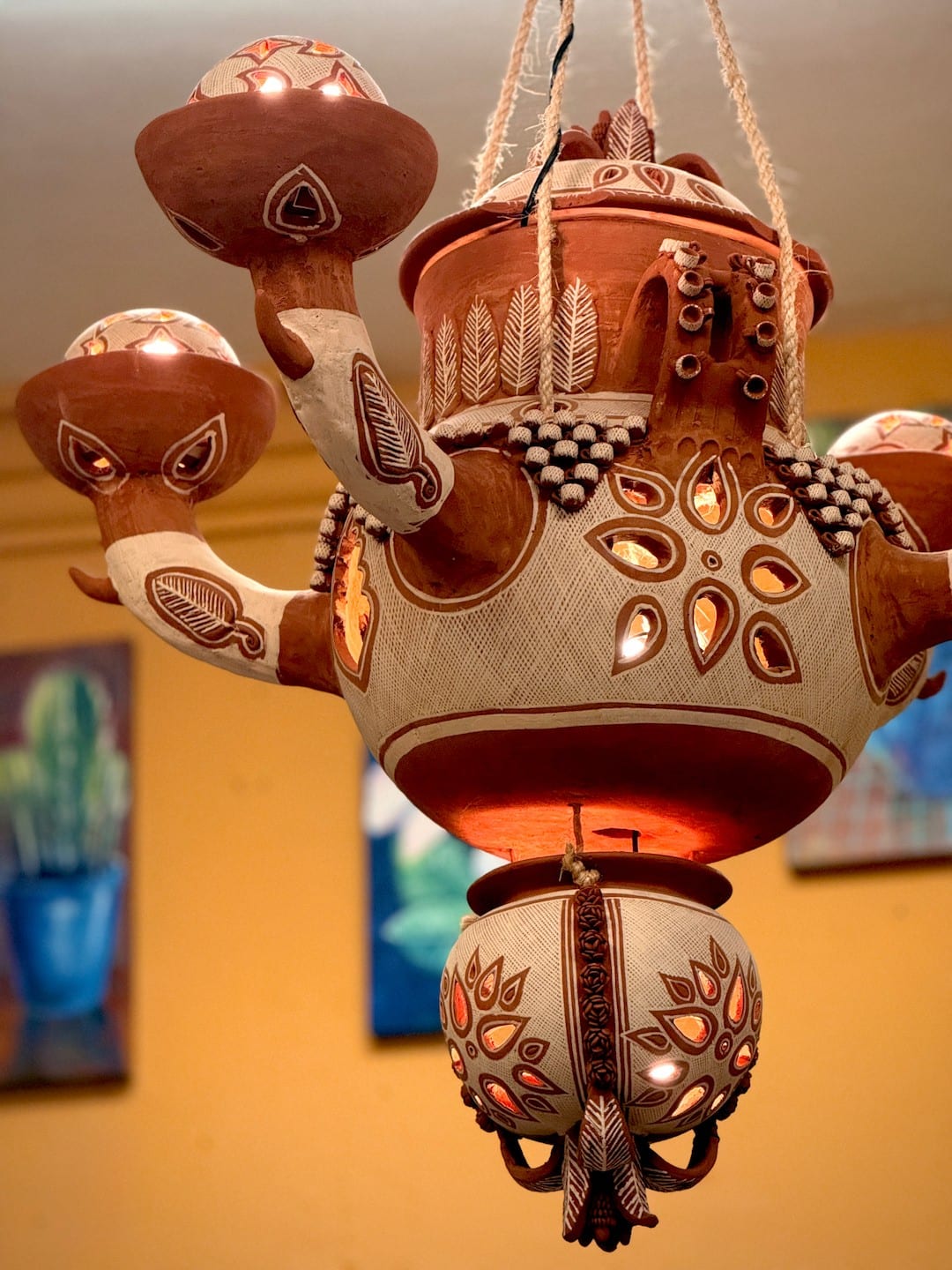
There is also a chandelier: red clay pierced through so the light comes out in points, hung with modeled fruit and leaves. Lit, it throws a warmer light than any shade, and it is the piece people ask about most.
No two of them are the same
Put two pieces from the same workshop side by side and the differences show straight away. A band of combing runs a little wider on one. A modeled leaf curls further. One lid sits a fraction prouder than its neighbor. That is what happens when a form is made by hand rather than pressed in a mold.
It is worth knowing before you choose. If you want a pair, buy the pair you have seen together, because two pieces of the same design are close relatives rather than twins. If you are buying one, those small differences are usually the part you end up liking most.
Knowledge that was meant to be shared
Don Neftalí shared his knowledge generously with schools and with other artisans in the area. Today his legacy lives on through his son, José Neftalí Ayungua, and the many artisans he mentored throughout his career.
That continuity is part of why we go back to the same workshops year after year rather than looking for whatever is easiest to source. There is more about how we work on our story page.
Living with Patambán pottery
These pieces like a little space and a little height. One large vessel on a console reads better than three crowded onto a shelf, and the red looks completely different against pale plaster than it does against dark wood. Put one where the afternoon light crosses it and the white detail lifts off the surface.
Red clay sits easily beside leather, jute, worn timber and unbleached linen, which covers most of what we carry in furniture. If you are building a room around one strong object, this is a good object to build around.
The chandelier is the exception to the space rule, because it takes none. Hung over a dining table or in a stairwell it does its work overhead and leaves every surface free.
Most of the Patambán work moves through our showroom in Cabo San Lucas, where you can pick a piece up and turn it over. What is on the floor changes as pieces arrive and leave, so if something has caught your eye, ask us and we will tell you what is in.